Sunday, March 28, 2010

Next Up! Celeriac


Yes it is 6am and I am up playing in the mud. Still -10c this morning but double digit temperatures are forecast for next week.

So next out of the seed bag is something new and unusual to most of us. Celeriac. Yes it is a member of the celery family with a celery like taste. Used boiled, mashed or cut into cubes for stews or soup. Sometimes called knob celery it is a root vegetable. Check out the link on this blog that will give you info on "What To Do With This Stuff".
It is a tad ugly in looks and requires a very long growing season so I may be a bit optimistic but I thought it worth a try as apparently the roots can be stored for a longer period than celery.
The variety is called Brilliant and is seed from Hope Seeds in New Brunswick. So keep your fingers crossed and if you pray to the celery gods, mores the better!

Saturday, March 27, 2010

In The Beginning There Was Celery!


Now do not let that -10c temperature get you down. Pay no attention to the blizzard like conditions I see out my kitchen window. Give no heed to the bears who are now scurrying back to their dens thinking they may have waken a tad early! Nope. These signs are simply a mask. A charade. A test of our mettle!
Well I for one thumb my nose at Mother Nature and will simply go about my business of pretending it is really Spring.

Today is Day 1. Oh the smell and the touch of soft damp potting soil. The pleasant sound of the trowel mixing the soil with the water. The feel of dirt under my fingernails! The satisfying plop as the seed trays are filled! The sound of the ambulance arriving and the men in white coats who want to put me a funny jacket. Granted it is not the bright red Lower Shinimicas mud I am playing in as it is a bag of organic potting soil, but, it felt soooo good!

So Celery is first out of the shoot and you can see the trays in the picture, delicately placed on the "official seed sprouting device" or the OSSD for technical types. ( really just a old wooden shelf in the kitchen by the heat register but for a few months it is the "OSSD")

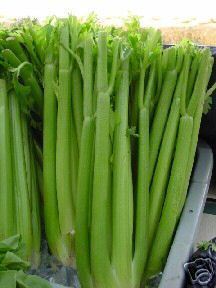
This is my second kick at the can with celery. The variety is called Tall Utah which is organic seed from Hope Seeds. You may remember that last year the celery was short and strong in flavor. Some found it good for soups but too strong for raw eating. I was late starting it last year which accounts for the size and I did not blanch it which is why it was a deep green and not the pale stalks you see in the supermarket.

This year I am getting an early start and I am going to attempt to blanch the stalks. This means that in the last 3 weeks or so of growth I will attempt to block the light getting to the stalks by mulching them heavily or surrounding them with something to keep light off the stalks.

If any of you buy juice or milk in the 2 liter size cartons could I impose on you to save me some? Do not flatten them. I am going to try and use them to blanch the celery later in the season by using them as a sleeve right over the plant. Just the top would stick out.

Celery is considered one of the most difficult vegetables to grow sucessfully but I learned much last year and have high hopes that it will go well this year. well maybe. It took me four seasons to learn how to grow broccoli!


Saturday, March 13, 2010

What Are We Growing This Year!


The seeds have arrived with the exception of the potato sets which I will pick up later in the season. It is always exciting to see all the seed packages and to think that each package contains life waiting to burst! The picture shows a few of the new seeds but I have boxes and containers of collected seed on top of the new seed.


So what is going into the bright red Lower Shinimicas mud this season? Drum roll please! Roll out the red carpet and admire this stunning line up for 2010!


Arugula- A peppery green for salads.

Beans- green, Beans- french green, Beans- French yellow (new!)

Bulls Blood Beets- The best purple beet greens ever!

Brocolokoli Brocolokolie

Red Cabbage

Carrots- Scarlet Nantes, Danvers 126, Yaya(new!)

Celery (still learning, have some ideas to improve on last years offering)

Celeriac (new!)

Corn Salad- A salad green

Cucumber (English style)

Eggplant (with luck I might even get blossoms this year!)

Kale- (just for Todd)

Kohlrabi

Lettuce- Mesculan, Lolla Rosa, Romaine, Butterheads

Melon (maybe, maybe....)

Mizuna- New oriental green!

Nasturtiums- Yummy peppery greens!

Onions (red and white)

Pak Choi (New!)

Parsnips

Peas (snow and green)

Peppers (hot and sweet)

Potatoes( red and white)

Pumpkin(small sugar for pies)

Radish

Spinach

Squash( Buttercup & Butternut)

Swiss Chard

Tatsoi(New oriental green!)

Tomatoes- Brandywine, San Marzino, Early Latah, Tribes Tobique,
Red Pear Tomato (New)

Turnip(Purple Top and standard)

Zuchini.


A few herbs- Basil, Thyme, Parsley, Lemon Balm, Tarragon, Mint, Dill


Whew. Someone is going to be very busy this Spring and I have it on authority that he cannot wait to get er done!


So there you have it Ladies and Gentlemen a star studded cast for your munching pleasure. I accept this award on behalf of all the little people who live in my soil and do so much for so much goooood taste!


Sunday, February 21, 2010

The Plots Thicken


Now while the snow lays thick on the gardens it is time to firm up just what goes where in the garden. This is critical to those concerned about keeping the soil healthy.

Potatoes cannot be planted where potatoes have been in the last 3 seasons and 5 seasons would be best. The Cole crops (broccoli, cabbage, kohlrabi, radish, turnip etc) have a similar requirement. Rotating the crops around to meet this requirement is like a big jigsaw puzzle. The picture of the spread sheet is my attempt to log what has been in each plot in the past and what should go in each plot in the new season.

Why is this important? Each crop has different nutritional needs and takes different nutrients, in different quantities out of the soil. Some crops have deep roots and bring nutrients up from a much deeper level then those with shallow roots. Planting the same family of vegetable in the same plot year after year also helps the bad bugs find their dinner much easier! It also promotes diseases that are peculiar to that vegetable and causes them to be persistent in the soils.

So, when one grows vegetables without chemical fertilizers, pesticides & fungicides it is important to change up the game on the bad little bugglies and move their dinners around the garden to confuse them! It also helps ensure the soils stay healthy and soil health is the most important aspect of growing naturally.

So on snowy February Sundays you will often find me with my spread sheets planning the what goes where. It is not as much fun as weeding but it is a job that has to be done!

Saturday, January 30, 2010

It's a Seedy Business!


Hard to believe it is that time of year again but here we are into the new year and the vacation from all things gardening is over. My first task is to take stock of my seed on hand, decide what is good or questionable and what I need more of and what new crops I might trial.

I do collect as much seed as I can from things like beans, peas, squash, tomato, pumpkin and I even have a little lettuce seed collected from last year. Seed collecting is something I am continuing to learn and each year I add a little bit more.

I try to order open pollinated seeds when possible or practical as hybrids do not allow for seed saving as they do not stay true in the next generations.

I look for heirloom varieties as I feel it is important to keep these older varieties active and often, like Brandywine tomatoes, they taste the best! All of the tomato varieties I now grow are types I can collect seed from each year.

I try not to buy treated seed but if there is a vegetable I love and it is only in treated seed I will buy it.

How much seed to buy is still a bit of guess work for me. I am trying to keep better records of how many feet or number of plants were required for last years distribution. For example last year there were 7 shares in the garden and I grew 200ft of carrots. I had lots of carrots even with part of the crop not coming up well. This year there may be 8 shares so I will add another 25ft of row. I know if I was doing this full time I would be more scientific but this is a hobby so I build data bit by bit as time allows.

So once I have decided what I have on hand, what new items I wish to add and I then have to decide where I am going to purchase the seed. I use two suppliers for almost all of the seed I buy. Hope Seeds from New Brunswick and Vesey's Seeds from Prince Edward Island. I like to keep it local but once in a while have ordered some special things from suppliers in Ontario and British Columbia.

Hope Seeds is a very exciting small independent seed house that has interesting heirloom and organic seeds for quite a number of vegetables. They are not cheap but their seeds germinated well for me and it is wonderful to have this source close to home. If you are planting a little backyard garden check them out at http://www.hopeseed.com/index.html

The mainstay of my seed supplies is Vesey's. They are reasonably priced. The quality and performance of their seed is very very consistent. Their customer service is impeccable if there is a problem. They are adding more heirloom, open pollinated varieties. Local and a long time family operation we are fortunate to have them in our area. http://www.veseys.com/ca/en/about

We often take our food so much for granted and forget it starts with seed. Having a consistent source for seeds is a matter of life and death. Like most industries there has been consolidation of seed suppliers over the years and with that the old varieties are often dropped in favour of the hybrids. There has become a serious concern re the diminishing bio diversity available and there are organizations now that focus on keeping the older varieties available. Often these older types are not favorable for large scale farming operations as they do not grow as uniform as the new hybrids so they are dropped from the catalogues. Large scale farming equipment requires the plants to grow and mature uniformly and the old styles do not.

Okay so now I simply go to the web pages and place the orders. Step 1 for 2010 completed!

Saturday, January 23, 2010

The Farm!


The Farm consists of approximately 3 acres of wondrously fertile deep red northern Nova Scotia clay. This is the last parcel of an original 50 acre farm purchased by my parents in 1946. I moved back home to the farm in 1999 and started my first vegetable garden. I was hooked. I began reading all I could about vegetable growing. I discovered organic growing and began to wean my garden off of chemicals back in 2002. I was inspired by the writings of Eliot Coleman, Ruth Stout, J.I Rodale, Masanobu Fukuoka and many others.

As I grew more and experimented more I ran into a problem. What do I do with all this stuff? This is not my day job, this is a hobby, but, still, what to do. Could I sell at the road side? Peddle to the cottagers at the beach? Find a weekend farmers market? None of these really fit my situation. Maybe when I retire but not really for today.Then I stumbled on an idea.

I came across information for a form of agriculture called Community Supported Agriculture or as commonly known, CSA. This was very interesting. A group of people contract with a grower to grow food and they agree to pay the grower for a "share" of the crop. The farmer gets paid at the start of the season and once the crops come on, each shareholder gets a weekly share of the crops in season. The farmer applies the work and expertise, the shareholder supports financially and both share the risks and rewards of the growing season.

The experiment began in 2007 when a co-worker was excited to be my guinea pig and was inspirational in getting me going, as I was a little nervous. Could I grow good enough food for someone else's table! Well it seems I could

The experiment continues and now there are 6 shares on the go. I am having a ball and they seem to like what I grow and I am growing things I never dreamed of trying before. Some fail and some are winners.

I am not certified organic but I do not use chemicals on my land. Any outside sourced inputs I use are organic if at all possible. I do use, when pushed, a little bit of organic pesticide but only as a last resort as usually I grow enough to let the bugs have their fair share. Hey, they gotta live to, besides if you kill all the bad bugs you leave nothing for the good bugs to eat! I mulch the gardens heavily with hay/grass I cut with my scythe as this is free fertilizer and great exercise.

I am learning more every year and my only regret is that I did not start sooner in life. To grow nutritious food in a environmentally friendly way is not only a great challenge it is great fun!